



Everyone is talking about GEO, Generative Engine Optimisation. How to get your brand cited in ChatGPT. How to appear in Google AI Overviews. How to stay visible in a world where AI is answering questions before users even click a link.
But most of the conversation focuses on the obvious tactics: backlinks, structured content, brand mentions. Very few people are talking about one of the most quietly effective GEO strategies available right now: glossary pages built around entity SEO.
It sounds technical. It is actually quite simple. And it works.
What Is Entity SEO?
Before diving into glossary pages, it helps to understand what entity SEO actually means.
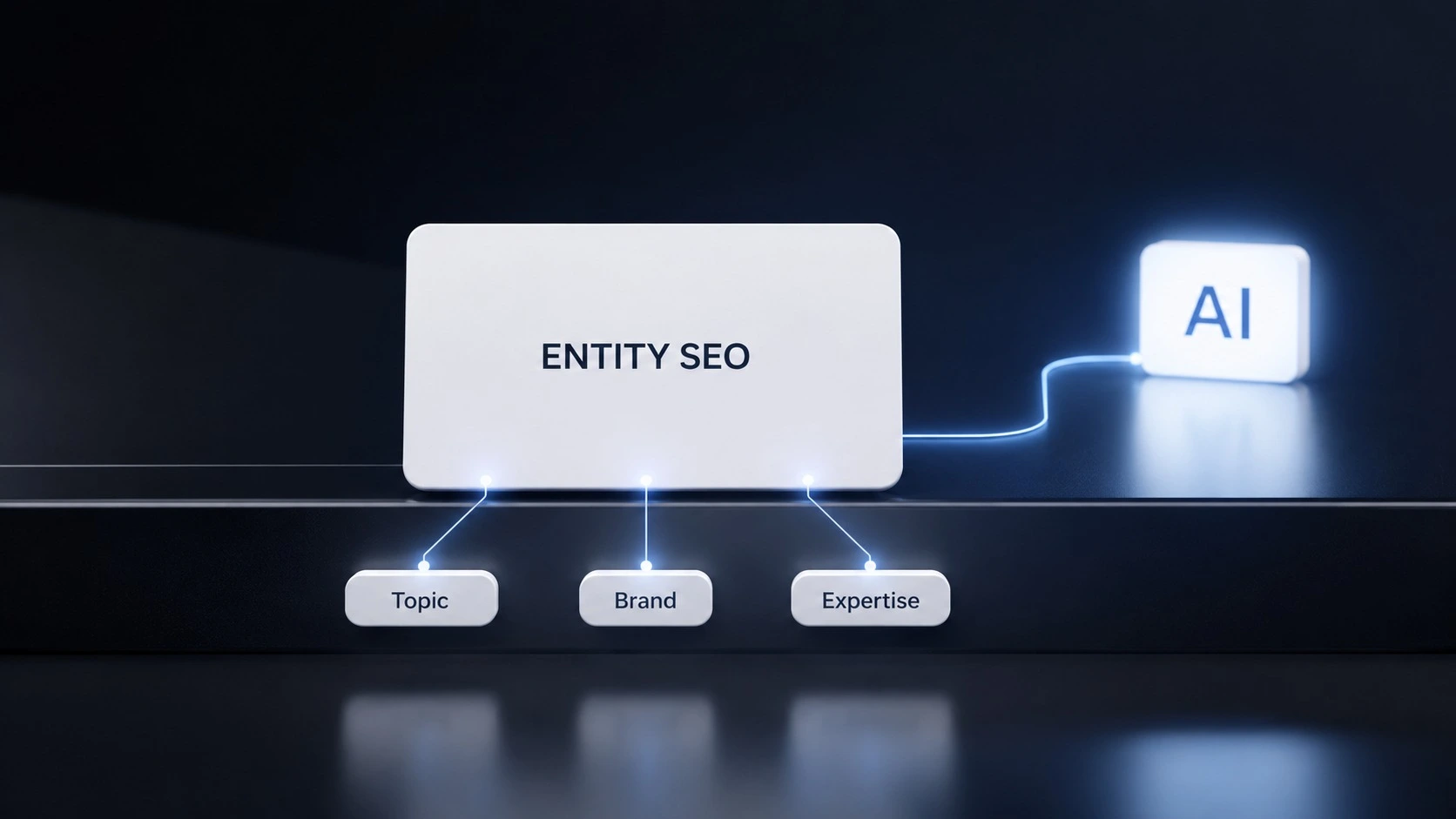
In traditional SEO, search engines matched keywords, specific strings of text, to relevant pages. Entity SEO goes a step further. It is about helping search engines and AI systems understand concepts, not just words.
An entity is anything that can be distinctly identified: a person, a place, a brand, an idea, a product. When Google or an AI model understands that your brand is a recognised entity associated with a specific topic, it starts treating you as an authority on that subject, not just a page that happens to contain certain keywords.
Entity SEO is essentially the difference between Google knowing your keywords and Google knowing who you are.
Where Glossary Pages Come In
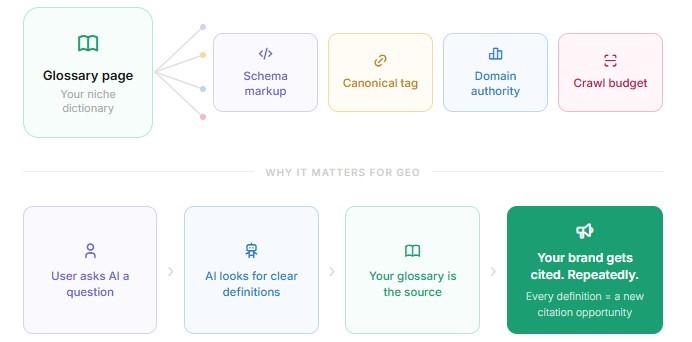
A glossary page is a dedicated section of your website that defines industry-specific terms clearly and accurately. Think of it as a mini-dictionary for your niche.
For an SEO agency, that might include definitions of terms like “domain authority,” “crawl budget,” “canonical tag,” or “schema markup.” For a legal firm, it could be definitions of common legal terms their clients search for.
Here is why this matters for GEO: AI models like ChatGPT and Google’s AI Overviews are constantly looking for clear, reliable definitions to pull into their answers. When a user asks “what is schema markup?” the AI wants a source that explains it cleanly and authoritatively.
If your glossary page is that source, your brand gets cited. Repeatedly.
Why This Tactic Is So Underused
Most businesses skip glossary pages for one of two reasons. Either they assume their audience already knows the terminology, or they do not see the immediate SEO value in definition-style content.
Both assumptions are wrong.
Even sophisticated buyers search for term definitions, often to double-check their understanding or to share with a team member. And from a search and GEO perspective, definition content is among the most citation-friendly formats that exists. It is structured, specific, and easy for AI to extract and reference.
The businesses that build comprehensive glossary sections today are quietly building a citation pipeline that their competitors are not even aware of.
The Entity-Glossary Connection
Here is where it gets interesting. Every term you define on a glossary page is an opportunity to strengthen your brand’s entity associations.
When your website consistently defines, explains, and contextualises terms within your industry, and does so in a way that is linked, internally connected, and structured with proper schema, search engines start associating your brand with that entire knowledge domain.
You are not just a website that ranks for a few keywords. You are a recognised entity in your field. That distinction matters enormously in an AI-powered search environment, where being known for a topic is worth far more than ranking for individual phrases.
How to Build a Glossary Page That Works for GEO?
Getting this right does not require a massive investment of time or resources. It requires clarity and consistency.
- Start with 20 to 30 terms your customers genuinely search for or ask about in conversations
- Write definitions in plain language, clear enough for a first-time reader, detailed enough for someone who wants depth
- Add FAQ Schema markup to each definition so AI crawlers can extract it cleanly
- Link each glossary term to a relevant service page or blog post on your site; this builds internal authority
- Update the glossary regularly; stale definitions signal to AI that your content may not be current
The goal is not to build the biggest glossary. It is to build the most trustworthy one in your niche.
The Compound Effect Nobody Talks About
Here is what most people miss about glossary and entity SEO: the results compound quietly in the background.
Every time an AI cites your definition, your brand gets an association. Every internal link from your glossary strengthens your site architecture. Every schema-tagged definition increases your chances of appearing in featured snippets and AI Overviews. None of these are dramatic overnight wins. Together, they build an SEO foundation that becomes increasingly hard for competitors to displace.
It is the kind of tactic that looks obvious in hindsight, and that is exactly why it is worth doing before everyone else catches on.
Ready to Build an SEO Strategy That AI Actually Notices?
At MIAAKA Tech, we help businesses in India build a digital presence that goes beyond rankings, one that earns citations, builds entity authority, and stays visible no matter how search evolves. If glossary pages, entity SEO, and GEO sound like the direction your strategy should take, let’s map it out together.